
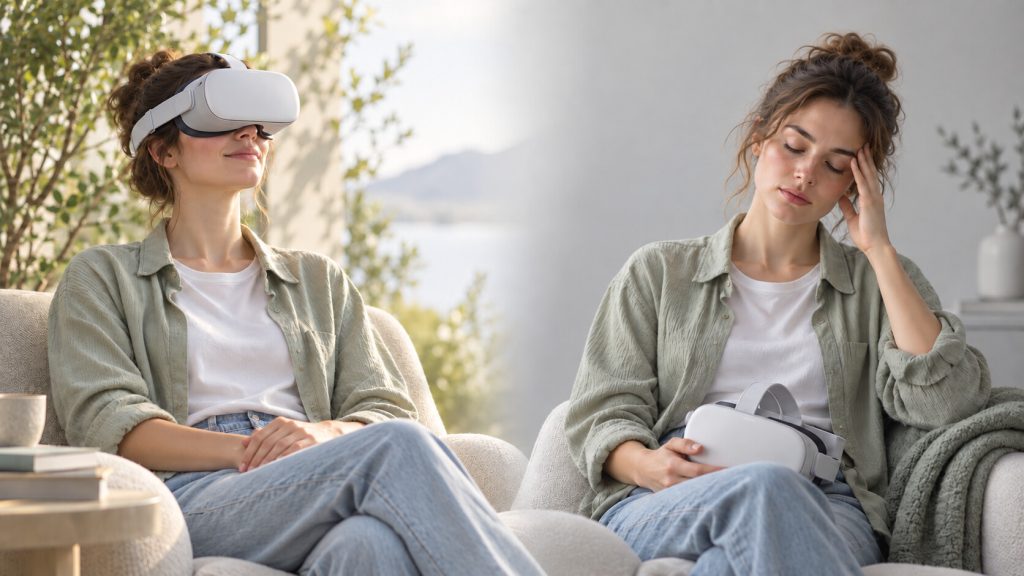
NatureVR is built on a simple premise: contact with nature supports young people’s mental well-being, and virtual reality can bring that contact to those who cannot easily get outdoors. Before the consortium designs its VR experiences, it is worth asking what the evidence actually supports and where the risks lie. This article summarises the current research and sets it against what young people and youth workers told us in the NatureVR needs assessment.
What virtual nature can do
Over the past decade, researchers have tested virtual nature – 360° videos and computer-generated 3D environments viewed through headsets — against a range of psychological outcomes. The findings are broadly consistent on one point: virtual nature reduces negative feelings.
A systematic review of 21 studies by Frost and colleagues (2022) found that virtual immersion in nature significantly decreased negative affect, although it did not consistently improve positive affect. A meta-analysis by Browning and colleagues (2020) reached a similar conclusion when comparing real and simulated nature: both reduced negative emotions, but real nature improved mood more than its virtual counterpart.
More recent syntheses have added detail. A meta-analysis published in Frontiers in Psychology (2022) reported that audio-visual exposure to simulated nature produced medium-sized increases in positive affect, vigour and calmness and a reduction in perceived stress, and that the level of immersion explained part of the difference between studies. A 2023 systematic review by Spano and colleagues extended the picture to outcomes such as nature connectedness and perceived vitality, while noting that cognitive performance does not appear to benefit from virtual nature alone.
The most recent review relevant to NatureVR’s target group is Hubbard and colleagues (2025), covering 24 experimental studies with higher education students. The authors conclude that nature replicated in VR shows promise for mental health and well-being but with two important caveats. First, study quality was mostly “fair” and samples were small. Second, in every study that compared VR nature with flat-screen images of nature, there was no significant difference in anxiety, mood or stress. The benefit may come from nature content, not from the headset.
For youth work, the practical reading is this: virtual nature is a reasonable tool for calming, stress relief and emotional recovery, and it can reach young people with limited access to green space. It is not a replacement for the real thing, and the immersive headset is not necessarily what makes it work.
Where the risks are
The risks fall into three groups.
Physical. The best-documented side effect is cybersickness: eyestrain, dizziness, disorientation and, less often, nausea – caused by a mismatch between what the eyes see and what the body feels. A 2024 systematic review of VR safety in children under 14 found that short, supervised exposure caused at most mild symptoms, not severe enough to stop participation, but also that safety data are poorly reported and the effects of repeated exposure remain unknown. A systematic review of ethical concerns by Kaimara and colleagues (2021) lists cybersickness, visual symptoms, sleep disruption and sedentary behaviour as the main physical concerns for children and adolescents.
Psychological and social. The same review flags emotional over-immersion, blurred boundaries between virtual and real experience, and the potential for overuse. These are concerns rather than established harms, the evidence base for adolescents is thin but they are the reason most guidance recommends short sessions, clear framing of the activity and the possibility to stop at any time.
Ethical and practical. Consent (including parental consent for younger participants), data collected by headsets and platforms, age-appropriate content and equal access are recurring themes across the literature. Cost and equipment availability are a risk in their own right: if VR is only available to well-funded organisations, it widens rather than narrows the gap for young people with fewer opportunities.
What our own research adds
The NatureVR needs assessment, carried out in 2026 with 110 young people in focus groups and 259 youth workers in an online survey, mirrors the research almost exactly.
Young people were open to VR nature but clear that it should not replace real outdoor experience – “don’t overdo it” was the recurring message. Youth workers ranked accessibility and cost (50%), digital addiction or overuse (47%), reduced engagement with real-world nature (38%) and data privacy (38%) as the most relevant risks. 90% said clear ethical guidelines are necessary before VR is used with young people. Only 22% of their organisations have access to a headset.
How NatureVR responds
These findings shape the design of the project’s VR experiences and training:
- VR nature is positioned as a complement to real nature, embedded in sessions that also include outdoor activity where possible.
- Experiences are short, calm and guided, with the young person able to remove the headset at any point.
- Every experience is available in two versions for full VR headsets and for low-cost cardboard viewers so that access does not depend on budget.
- Ethics and safeguarding form the opening module of the youth worker training, not an appendix.
- Young people are involved in testing and co-design before anything is released.
The full needs assessment reports will be published on nature-vr.eu.
Sources
- Browning, M. H. E. M., Shipley, N., McAnirlin, O., Becker, D., Yu, C.-P., Hartig, T., & Dzhambov, A. M. (2020). An actual natural setting improves mood better than its virtual counterpart: A meta-analysis of experimental data. Frontiers in Psychology, 11, 2200. https://doi.org/10.3389/fpsyg.2020.02200
- Frost, S., Kannis-Dymand, L., Schaffer, V., Millear, P., Allen, A., Stallman, H., Mason, J., Wood, A., & Atkinson-Nolte, J. (2022). Virtual immersion in nature and psychological well-being: A systematic literature review. Journal of Environmental Psychology, 80, 101765. https://doi.org/10.1016/j.jenvp.2022.101765
- Hubbard, G., Verde, P. A., Barrable, A., O’Malley, C., Barnes, N., & Toner, P. (2025). A systematic literature review and meta-analysis of virtual reality nature effects on higher education students’ mental health and wellbeing. Applied Psychology: Health and Well-Being, 17(5), e70060. https://doi.org/10.1111/aphw.70060
- Kaimara, P., Oikonomou, A., & Deliyannis, I. (2021). Could virtual reality applications pose real risks to children and adolescents? A systematic review of ethical issues and concerns. Virtual Reality, 26, 697–735. https://doi.org/10.1007/s10055-021-00563-w
- Effects of immersion in a simulated natural environment on stress reduction and emotional arousal: A systematic review and meta-analysis (2022). Frontiers in Psychology, 13, 1058177. https://doi.org/10.3389/fpsyg.2022.1058177
- Safety of virtual reality use in children: A systematic review (2024). European Journal of Pediatrics. https://doi.org/10.1007/s00431-024-05488-5
- Spano, G. et al. (2023). Virtual nature and psychological and psychophysiological outcomes: A systematic review. Journal of Environmental Psychology, 89, 102044. https://www.sciencedirect.com/science/article/pii/S0272494423000920
- NatureVR (2026). Youth Workers’ Needs Assessment Report, Activity 2.2 (BACKSLASH) and Young People’s Needs Assessment, Activity 2.1.