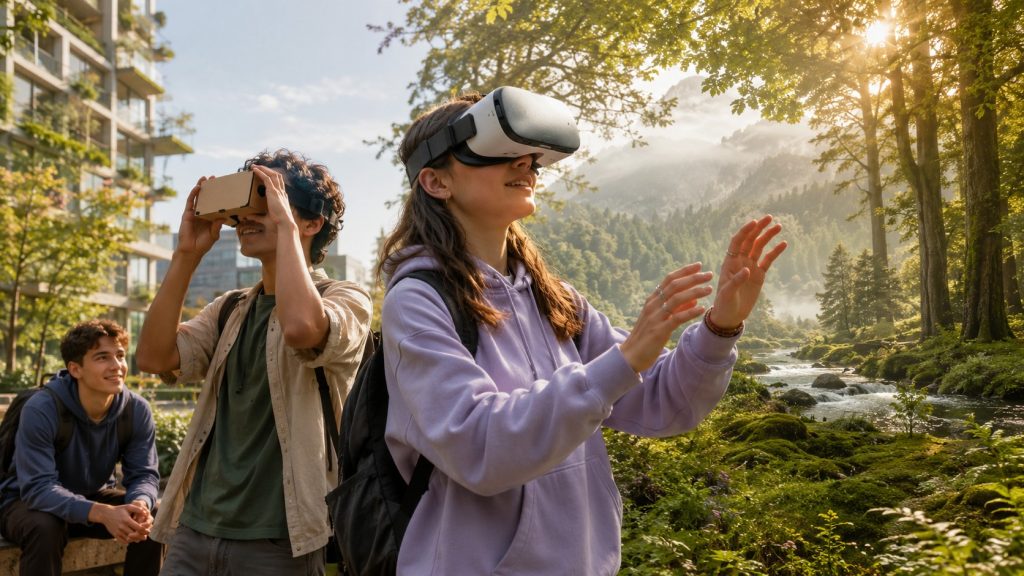
NatureVR invites youth workers to take part in a needs assessment survey
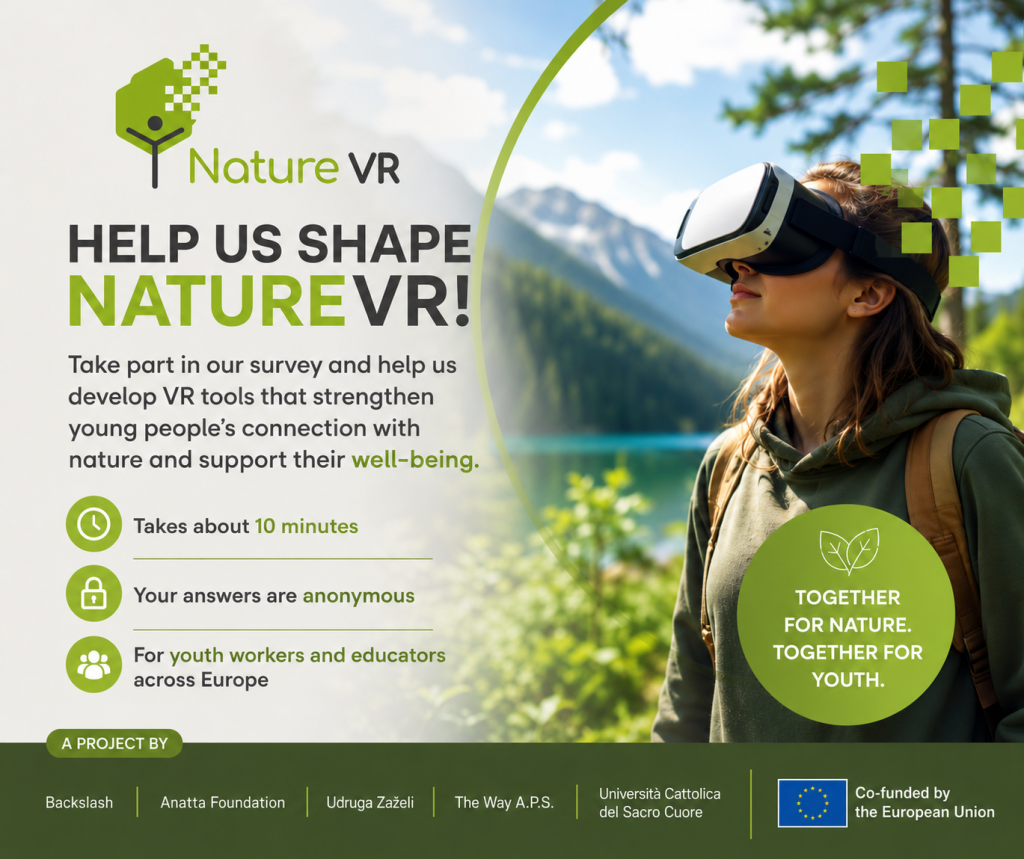
The NatureVR project has launched a short needs assessment survey for youth workers, educators, trainers and professionals who work directly with young people. The purpose of the survey is to better understand the current skills, knowledge, resources and training needs related to nature-based learning and the use of Virtual Reality tools in youth work.
NatureVR is an Erasmus+ project implemented by partners from Spain, the Netherlands, Croatia and Italy. The project focuses on developing innovative VR tools that can strengthen young people’s connection with nature and support their emotional, cognitive and social well-being.
Today, many young people spend a significant part of their lives in digital environments, while opportunities for meaningful contact with nature are often limited. At the same time, youth workers and educators are looking for new methods that can make learning more engaging, inclusive and connected to the real needs of young people. NatureVR responds to this challenge by exploring how immersive technologies can be used together with nature-based learning approaches to create meaningful educational experiences.
The survey is an important first step in the development of the project. It focuses on the experiences of youth workers and asks about their current practices, confidence, needs and expectations when it comes to using nature, experiential learning and digital or VR tools in their work. The results will help the project partnership design educational materials and VR-based tools that are practical, accessible and relevant for youth work settings across Europe.
The survey takes approximately 10 minutes to complete, and all answers are anonymous. Participants may also translate the form into their own language using the browser translation option.
The NatureVR partnership includes Backslash from Spain, Stichting Anatta Foundation from the Netherlands, Udruga Zaželi from Croatia, The Way A.P.S. from Italy and Università Cattolica del Sacro Cuore from Italy.
We invite all youth workers, educators, trainers and professionals working with young people to complete the survey and contribute to the development of innovative tools that connect nature, technology and youth well-being.
Listening First: NatureVR Launches Its Research Phase Across Four Countries
Before designing any tool, you need to understand the people it is meant for. That is the principle behind WP2, NatureVR’s research and analysis workpackage, which is now in full swing across Spain, the Netherlands, Croatia, and Italy.
Hearing from young people directly
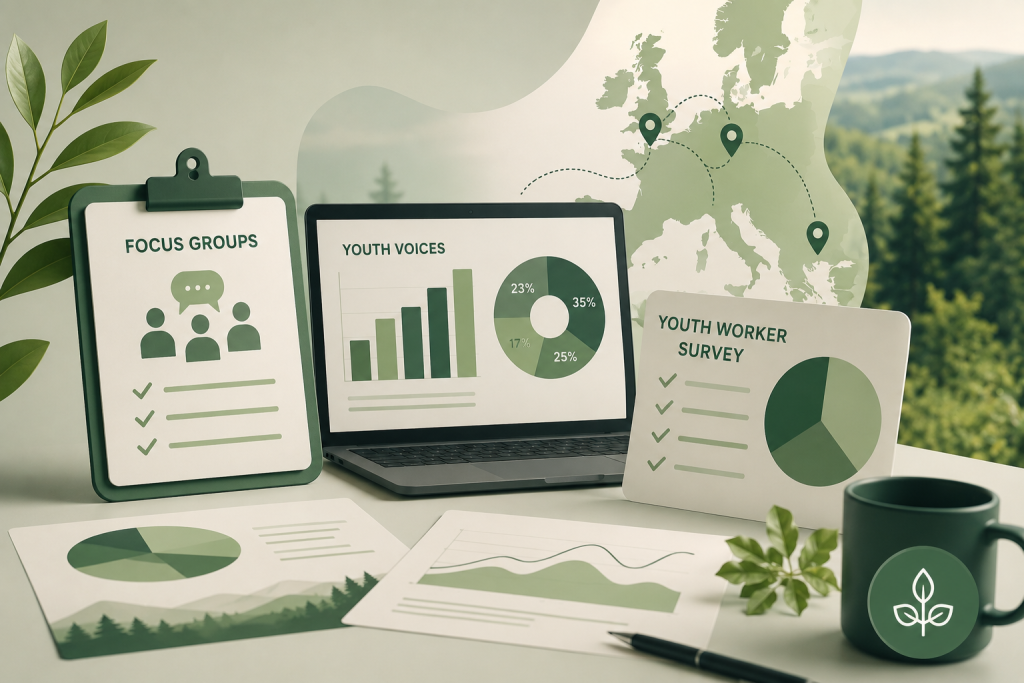
The first activity of this phase is a series of focus groups bringing together young people aged 18 to 30 from the partner countries. Facilitated by BACKSLASH (Spain), Anatta Foundation (Netherlands), and Udruga Zazeli (Croatia), these sessions are designed to explore a deceptively simple question: what is young people’s relationship with nature today, and what gets in the way of a deeper connection?
Participants are invited to reflect on their own experiences and not just whether they spend time outdoors, but how they feel about nature, what barriers they face, and what they would expect from a digital tool designed to bring them closer to the natural world. Eight focus groups are being conducted in total, with around 120 young people taking part across all countries.
What youth workers have to say
Running in parallel, a structured online survey is reaching youth workers across the consortium countries. This second strand of the research focuses on the professional perspective: what challenges do youth workers encounter when trying to integrate nature-based or digital approaches into their practice? What competencies do they feel they need? What would make a VR tool genuinely useful in their work?
The survey complements the focus groups by capturing the practitioner’s view, the people who will ultimately use NatureVR’s tools with young people on a daily basis.
Why this phase matters
The findings from both activities will feed directly into the design of NatureVR’s VR experiences and training materials. Nothing will be built on assumptions. The consortium is committed to co-creation, and that starts here: with real voices, real contexts, and real needs shaping every decision that follows.
Results are expected by mid-2026. Stay tuned to nature-vr.eu for updates as the research phase progresses.
Can Virtual Nature Actually Be Good for You? What Research (and Three Apps) Are Telling Us
Let’s start with an uncomfortable question: if you can’t get to the mountains, if you live in a grey city, if you struggle with social anxiety or simply don’t have the time – can you still “recharge” through nature? And does it even count?
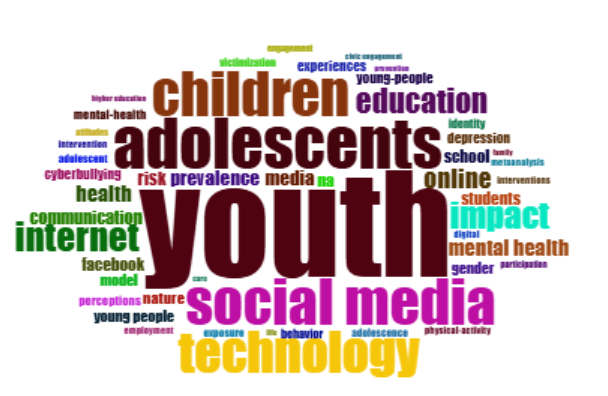
Surprisingly, the answer is: maybe yes. And research is starting to take that seriously (Figure 1.)
Figure 1. Word cloud, based on 500 keywords, represents the absolute frequency of the most used keywords about nature, virtual reality and youth.
VR and Nature: Not Sci-Fi, Just Well-being
There’s a fairly recent body of research – we’re talking about the post-2019 period, when consumer VR headsets really took off – exploring exactly this: how beneficial can immersion in virtual natural environments actually be, especially for people aged 18 to 30 who face real-world barriers to accessing nature?
The question isn’t just “does it work or doesn’t it?” The more interesting one is: how do you do it ethically and effectively? How do you balance the psychological benefits – less stress, better mood, a stronger sense of connection to the natural world – against very real risks like cybersickness or the disorienting feeling that prolonged headset use can sometimes leave behind (LaViola, 2000)?
This balance matters, especially when we consider that access to natural environments is far from equal. Urban youth, people with mobility limitations, and those living in nature-deprived areas are precisely the groups who might benefit most from virtual alternatives – and the ones most likely to be overlooked in research design (Soga & Gaston, 2016).
The Theoretical Backbone: Why Nature Helps in the First Place
Before diving into the apps, it’s worth pausing on why nature exposure benefits us at all. Two frameworks dominate the literature.
The first is Attention Restoration Theory (Kaplan & Kaplan, 1989; Kaplan, 1995), which argues that natural environments restore our capacity for directed attention by engaging what Kaplan calls “soft fascination” – gentle, effortless engagement that lets the mind recover from cognitive fatigue. Think of watching leaves move in the wind. You’re paying attention, but it costs you nothing.
The second is Stress Recovery Theory (Ulrich, 1983), which frames nature exposure as a physiological reset – lower cortisol, reduced heart rate, a nervous system that steps back from high alert. Both theories have decades of empirical support, and more recently, researchers have begun testing whether virtual natural environments can trigger the same responses (Chirico & Gaggioli, 2019; Browning et al., 2020).
The short answer: often, yes – though the mechanisms and the magnitude still vary quite a bit depending on the quality of the immersion.
Wild Journey: Meditating in the Forest (Without Leaving Home)
The first app worth looking at is Wild Journey, and the concept is as simple as it is compelling: it guides you through immersive, nature-themed meditations. There’s a narrator (you can choose a male or female voice) who blends mindfulness techniques with nature storytelling, guided breathing exercises, high-quality nature soundscapes for free listening, and even multi-day journeys – like a “7-day forest retreat” – designed to build a lasting habit of connection with the natural world.
The underlying idea is that through this kind of practice, the boundary between self and nature begins to dissolve. This isn’t just relaxation: it’s training in what researchers call environmental sensitivity – the ability to genuinely perceive and internalize one’s surroundings (Nisbet, Zelenski & Murphy, 2009). You’re not just unwinding; you’re rewiring how you pay attention to the living world.
The Nature Quotient framework (WWF, 2013), which the app implicitly draws on, measures this through two dimensions in particular: Spirit (a felt sense of oneness with nature) and Emotion (affective resonance with natural environments). Wild Journey targets both.
Seek by iNaturalist: The Birdwatcher Inside You (With Achievement Badges)
Then there’s Seek, which works in a completely different way but is just as interesting. Think of it as a real-world Pokédex: you go outside, point your camera at plants and animals, and the app identifies and classifies them. You earn badges for the species you observe, there are monthly challenges, and – almost without noticing – you start becoming genuinely more aware of the biodiversity around you.
What’s clever about Seek is how it uses gamification to do something serious: turn curiosity into real environmental literacy. It’s not just telling you “that’s a blackbird.” It’s teaching you to look at the world differently, to understand ecosystems, and to connect with a community of people who share those interests.
From a theoretical standpoint, this aligns well with research on citizen science and conservation behaviour (Bonney et al., 2014): when people actively participate in observing and documenting nature, their sense of environmental responsibility tends to grow meaningfully. The app targets two Nature Quotient dimensions – Cognition (stimulating curiosity and deeper ecosystem understanding) and Action (fostering active engagement and socialising through shared conservation goals).
Natural Atlas: The Field Guide of the Future
The third app, Natural Atlas, plays on yet another dimension: place attachment. It’s a GPS-powered naturalist guide that adapts to exactly where you’re standing. Original, richly detailed maps, hike tracking, field notes, and a personal profile that accumulates all your outdoor memories over time.
The theoretical lens here comes from Participatory Mapping (PPGIS – Public Participation Geographic Information Systems), a framework developed to understand how people build emotional and cognitive relationships with specific landscapes (Brown & Kyttä, 2014). By actively documenting the places you visit and the things you discover there, you’re not just recording data – you’re constructing what Scannell & Gifford (2010) call Place Identity: the way your self-concept is shaped by, and attached to, the natural places you inhabit.
Natural Atlas targets the same two Nature Quotient dimensions as Seek – Curiosity (cognition) and Action – but through a more personal, reflective lens. Less gamified, more journal-like.
So, Does It Actually Work?
The honest answer is: it depends on how you do it. Slapping on a headset and expecting miracles won’t cut it. VR platforms need to be carefully designed – high-quality content, multiplatform adaptability (the same experiences should ideally run on VR, desktop, and web to reach more users, including teachers in classroom settings), and genuine attention to physiological risks.
But what’s emerging from the research is that digital nature – done right – isn’t a lazy shortcut. It can be a genuine access point to well-being for people who would otherwise be excluded. And, in the best-case scenario, it can even become a first step towards a deeper, more conscious relationship with the real natural world.
Not bad for something that runs on a phone or a headset.
Are you exploring VR nature tools for education or well-being? We’d love to hear about your experience.
References
Bonney, R., Shirk, J. L., Phillips, T. B., Wiggins, A., Ballard, H. L., Miller-Rushing, A. J., & Parrish, J. K. (2014). Next steps for citizen science. Science, 343(6178), 1436–1437.
Brown, G., & Kyttä, M. (2014). Key issues and research priorities for public participation GIS (PPGIS): A synthesis based on empirical research. Applied Geography, 46, 122–136.
Browning, M. H. E. M., Mimnaugh, K. J., van Riper, C. J., Laurent, H. K., & LaValle, S. M. (2020). Can simulated nature support mental health? Comparing short, single-doses of 360-degree nature videos in virtual reality with the outdoors. Frontiers in Psychology, 10, 3124.
Chirico, A., & Gaggioli, A. (2019). When virtual feels real: Comparing emotional responses and presence in virtual nature and urban environments. Cyberpsychology, Behavior, and Social Networking, 22(12), 763–771.
Kaplan, R., & Kaplan, S. (1989). The Experience of Nature: A Psychological Perspective. Cambridge University Press.
Kaplan, S. (1995). The restorative benefits of nature: Toward an integrative framework. Journal of Environmental Psychology, 15(3), 169–182.
LaViola, J. J. (2000). A discussion of cybersickness in virtual environments. ACM SIGCHI Bulletin, 32(1), 47–56.
Nisbet, E. K., Zelenski, J. M., & Murphy, S. A. (2009). The nature relatedness scale: Linking individuals’ connection with nature to environmental concern and behavior. Environment and Behavior, 41(5), 715–740.
Scannell, L., & Gifford, R. (2010). Defining place attachment: A tripartite organizing framework. Journal of Environmental Psychology, 30(1), 1–10.
Soga, M., & Gaston, K. J. (2016). Extinction of experience: The loss of human–nature interactions. Frontiers in Ecology and the Environment, 14(2), 94–101.
Ulrich, R. S. (1983). Aesthetic and affective response to natural environment. In I. Altman & J. F. Wohlwill (Eds.), Behavior and the Natural Environment (pp. 85–125). Plenum Press.
WWF (2013). Reconnecting children with nature: A framework for developing the Nature Quotient. WWF-UK.
NatureVR: Bridging Youth and Nature Through Virtual Reality
Young people across Europe are spending more time in digital environments while reporting rising levels of stress, anxiety, and disconnection from the natural world. Conventional environmental education often struggles to reach a generation growing up in urban settings, where forests, rivers, and open landscapes are not part of daily life. NatureVR an Erasmus+ Cooperation Partnership in Youth (KA220-YOU) was designed to address exactly this gap.
Running from January 2026 to June 2028, the project brings together five partner organisations from four countries: Stichting Anatta Foundation (Netherlands) as coordinator, BACKSLASH (Spain), Udruga Zazeli (Croatia), The Way A.P.S. (Italy), and Università Cattolica del Sacro Cuore (Italy). The consortium combines hands-on experience in youth work with expertise in environmental psychology, digital pedagogy, and academic research.
What NatureVR delivers
At the core of the project is the Nature Intelligence (NQ) model a framework that links the emotional, cognitive, spiritual, and physical dimensions of how people relate to nature. The premise is straightforward: a deeper connection with nature supports young people’s mental well-being and encourages sustainable behaviour. NatureVR translates this framework into practical tools that youth workers can integrate into their everyday practice.
The project is co-developing immersive VR experiences grounded in the NQ model, available in two formats one for professional VR headsets and one for printable cardboard viewers that any organisation can assemble at low cost. This dual approach ensures that the tools remain accessible to youth organisations regardless of their technology budgets, and to young people with fewer opportunities.
Alongside the VR tools, the consortium is producing e-learning modules for youth workers, an intensive four-day Training of Trainers programme in Spain, and policy advocacy materials targeting regional, national, and EU-level decision-makers.
The numbers behind the project
Over 30 months of implementation, NatureVR will train more than 50 youth workers as multipliers, directly engage over 150 young people in testing and using the tools, and reach more than 30,000 stakeholders through its awareness campaign. Every project output; VR tools, learning materials, methodologies will be freely available under an open licence for at least five years after the project ends.
Values guiding the work
NatureVR rests on four principles: evidence-based design through collaboration with researchers in environmental psychology and cognitive science; inclusion by default through multilingual content, subtitles, audio descriptions, and a focus on youth with fewer opportunities; co-creation with youth workers and young people at every development stage; and openness and sustainability of results well beyond the project’s lifetime.
What comes next
In the coming months, the consortium is conducting needs assessments with young people and youth workers across the four partner countries the foundation on which the VR tools will be co-developed. Follow the project’s progress on nature-vr.eu and join us on the journey of using technology to bring young people back into meaningful contact with the natural world.
This website uses only essential cookies necessary for its operation. We do not use tracking or advertising cookies. See our Privacy & Cookie Policy.