
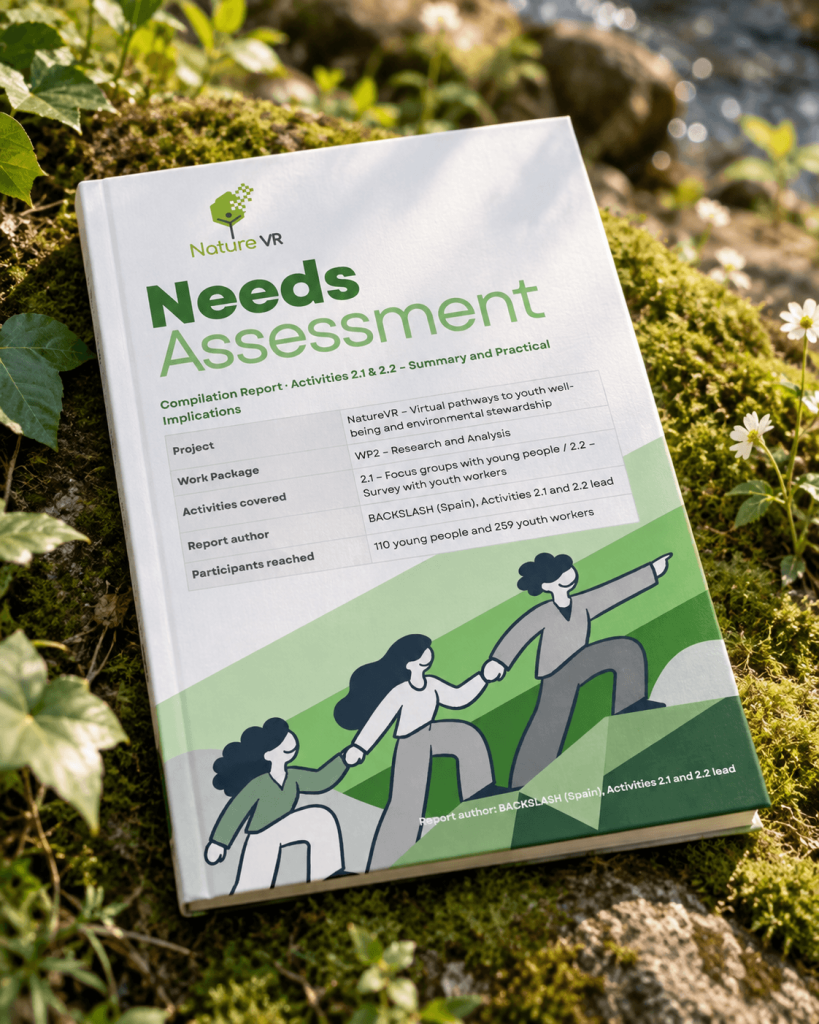
The NatureVR project – Virtual pathways to youth wellbeing and environmental stewardship has completed its needs assessment phase (Work Package 2), with the conclusions from two parallel activities now brought together in a single compilation report.
The research drew on two sources. Under Activity 2.1, eight focus groups were held with young people in Spain, Croatia and the Netherlands, reaching 110 participants. Activity 2.2 ran a survey among youth workers, gathering 259 responses, mainly from Spain, Croatia and Italy. Both reports are complete and satisfy the output indicators set in the project application.
One message from two independent sources
The most consistent finding of the whole phase is that VR should be a bridge to real nature, never a replacement for it. Young people across all three countries raised this concern in their own words — VR must not substitute for real outdoor experience. In parallel, 90% of surveyed youth workers agreed that clear ethical guidelines are necessary for using VR in youth work. The two signals align even though they come from different audiences.
Comfort, safety and accessibility
Both audiences share the same practical concerns. Young people raised motion sickness, eye strain and discomfort in every country. Among youth workers, 70.3% rated VR tools as only slightly or not at all accessible for young people with fewer opportunities. The conclusion is clear: NatureVR has to be genuinely comfortable and accessible, not just engaging.
Enthusiasm alongside a confidence gap
Interest exists on both sides, but so does an experience gap. Young people are curious about VR, especially for reaching places they cannot otherwise visit. Youth workers see the benefits, but 83% have never used VR professionally, and they rated their confidence in VR-specific skills the lowest of any competency measured — operating equipment at 2.36/5, adapting content at 2.51/5. Only 21.6% of their organisations have access to VR headsets. Both the tool and the training must assume a low starting baseline rather than prior familiarity.
Sound, simplicity and a clear purpose
Both reports point to the same practical fix. Young people rank sound as the top priority for making a VR experience feel authentic. Youth workers ask above all for practical training, ready-to-use materials and clear guidance rather than abstract concepts: 59.1% want hands-on work with equipment, 56.4% want in-person workshops, and 40.9% asked for a network to exchange experience.
What comes next
The findings feed directly into the project’s next phases. Shared risk themes — physical discomfort, data privacy, over-reliance on VR — give Activity 2.3 a ready-made starting list for in-depth risk analysis. The language young people use for nature — calm, restoration, connection, curiosity — will ground the competency framework in Activity 2.4. For tool design (WP3), the priorities are high-quality spatial sound, exotic and hard-to-reach environments, a visible pause/stop option and a no-headset alternative. For training (WP4), the priorities are hands-on in-person formats, basic theory before VR-specific skills, and inclusion as a dedicated module.
The phase concludes that NatureVR is solving a real, shared problem: young people are open to VR but want it to lead them back to real nature, while youth workers are willing but need practical, hands-on support to deliver it well.
Funded by the European Union. Views and opinions expressed are however those of the author(s) only and do not necessarily reflect those of the European Union or the National Agency in charge. Neither the European Union nor the National Agency can be held responsible for them.