
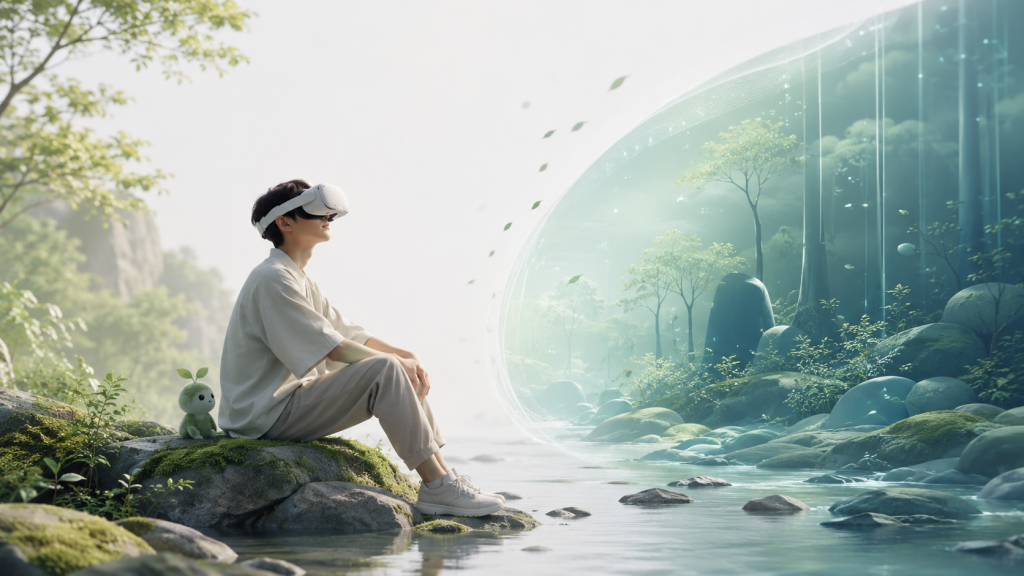
| A small note. This article tells a story, but not only a story. Hopir is an imaginary observer, a curious visitor from elsewhere, who arrives on Earth with a simple question: why does nature matter so much to humans? Through Hopir’s eyes, we can look again at something familiar, such as forests, water, mountains, silence, as if we were seeing it for the first time. For our project, the NatureVR Erasmus+, this is also a methodological question. If nature can move us, calm us, restore us, or make us feel connected, what happens when nature becomes virtual? Hopir’s journey helps us explore this question with a little awe, a little humour, and a serious research concern: how can we design virtual nature experiences that are not only beautiful, but meaningful, responsible, and useful for young people and youth workers? Let’s get started and enjoy the journey! |
Hopir arrives on Earth
Hopir had been observing Earth for some time before deciding to land.
From orbit, the data was clear enough: the planet was covered in organized patterns of rock, water, green matter and light. Coordinates were logged. Surface temperatures measured. Spectral readings filed away in the appropriate folders. Everything, in principle, accounted for. And yet.
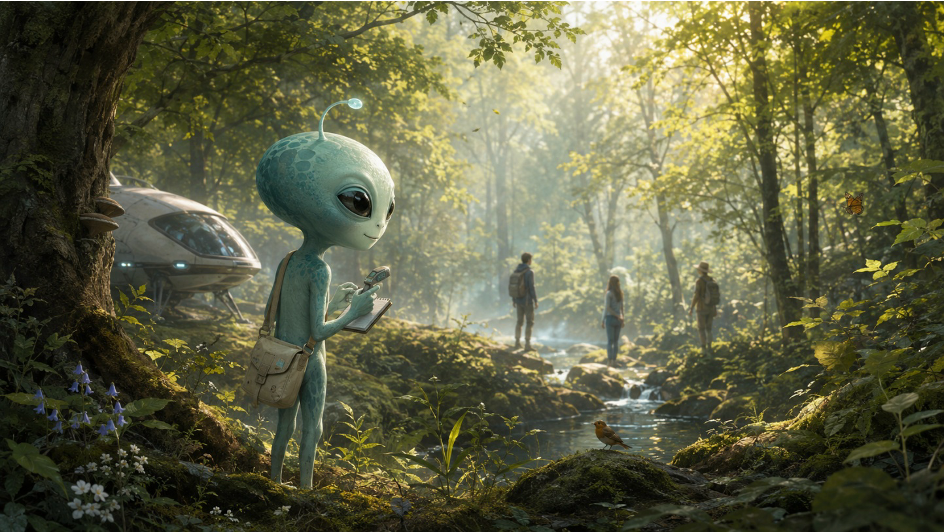
There was something in the human data that kept generating anomalies. Specifically, humans appeared to travel, sometimes considerable distances, sometimes at significant personal inconvenience, to reach places that offered no obvious functional advantage. No infrastructure. No commercial exchange. No particular efficiency of any kind. Just trees. Or water. Or mountains. Or the particular quality of silence that seems to exist only at altitude, between one gust of wind and the next.
Hopir decided the only reasonable thing to do was to enter a forest and observe directly. The first few minutes were promising. Green wavelengths: catalogued. Humidity levels: recorded. Irregular surface textures: noted. Bird vocalizations: identified and cross-referenced. Hopir’s instruments were working perfectly. But then something began to happen that the instruments were less prepared for. Humans nearby were changing. Not dramatically, no running, no shouting, no measurable physiological emergency. But they were moving more slowly. Speaking more quietly, when they spoke at all. Some were simply standing still, looking at nothing, with expressions that Hopir could only describe as: no longer anxious.
The forest, it appeared, was doing something. Not just containing information. Doing something to the people inside it. Hopir’s first research question formed itself, a little reluctantly: What, exactly, are humans feeling here?
Hopir’s first discovery: nature is something you feel
It would have been simpler if nature were only a setting. A backdrop. A collection of physical properties that human visual and auditory systems happen to process in one way rather than another. But the evidence suggested otherwise. A forest seems to slow people down, not because the terrain requires it, but because something about the density of green, the filtered light, the ambient sound, produces what researchers describe as restoration: a genuine recovery of attention, a reduction in the cognitive noise that accumulates in rooms, screens, streets and deadlines.
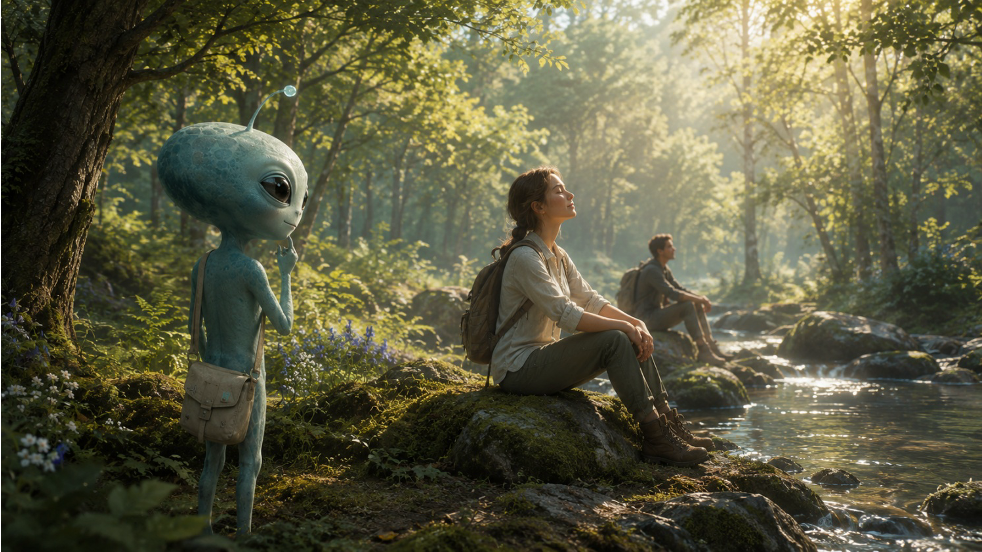
Near water, people become quieter still. In open landscapes, something else happens: a kind of expansion, an awareness of scale that produces feelings that are difficult to name but tend to involve feeling simultaneously very small and very calm. Hopir found this puzzling. Why would smallness be comforting?
And there was more. The same landscape could evoke different things in different people, and sometimes contradictory things in the same person: calm and nostalgia together; awe and a slight edge of fear; fascination and a strange, pleasant melancholy. Nature, it turned out, was not a simple emotional trigger with a predictable output. It was a complex relational experience, shaped by memory, attention, personal history: the felt sense of belonging to something larger than oneself. Hopir logged all this carefully and noted that the instruments were becoming progressively less adequate.
Hopir discovers virtual nature and a new question
Just when Hopir had begun to develop a tentative framework for understanding human-nature interaction, something even stranger came to light. Humans had started building forests inside machines. Not real forests, obviously. But virtual ones: digital landscapes with trees, light, sound, movement, depth. Environments that could be entered through a headset, experienced from the inside, and (this was the strange part) apparently felt in ways that resembled, at least partially, what happened in actual forests. Hopir paused the instruments and considered.
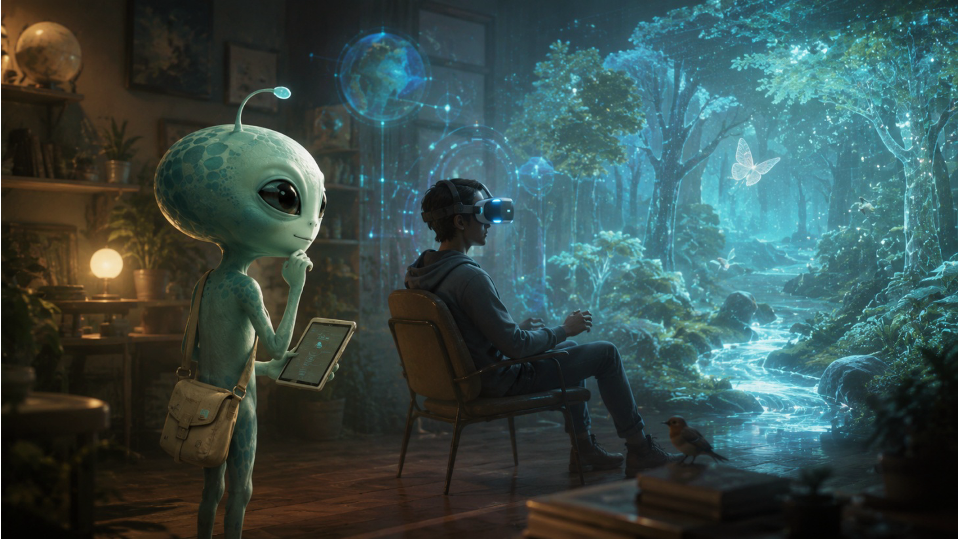
If humans could feel something in real nature, could be restored by it, moved by it, calmed or awed or quietly reconnected by it, what happened when nature became virtual? Was the feeling the same?
This became Hopir’s central research question, and, as it turned out, the central research question behind NatureVR: how much emotional distance is there between real nature and virtual nature?The question is not whether virtual nature can replace real nature, or whether pixels can replicate pine trees. The question is subtler and more interesting: what can virtual nature meaningfully do, under which conditions, and with which limits? And how can research help us understand this responsibly, before we start sending young people into digital forests and claiming it will change their lives?
From awe to methodology
Hopir’s initial hypothesis was, in retrospect, somewhat naive. If virtual trees look realistic enough, Hopir reasoned, humans will feel as if they are in nature. Research, however, has a way of complicating the obvious. Because the question is not really about realism; not primarily, anyway. But, it is about experience. Researchers investigating virtual environments have learned to ask a different set of questions.
What emotions does this environment actually evoke? Does the person feel presence inside the environment, or merely aware of watching it? Does the experience support calm, attention, curiosity, or restoration or does it produce discomfort, confusion, visual overload? Does it feel meaningful, or artificial in a way that creates distance rather than connection?
And then: what happens before the experience, during it, and after it ends? Which design elements support emotional engagement and which quietly undermine it?
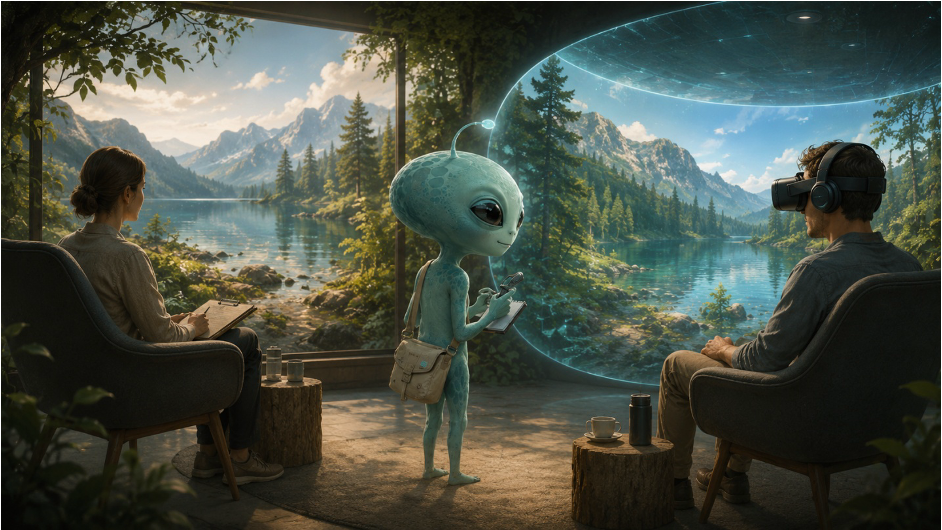
These are not questions you can answer by looking at the graphics. They require careful measurement, thoughtful comparison, and the willingness to be surprised by what the data says. This is where Hopir’s story moves from awe to research design.
What previous research tells us
Hopir was relieved to discover that this territory had already been explored, at least partially. Several researchers have been investigating exactly this question for several years. In one study (Chirico & Gaggioli, 2019), participants were exposed either to a real panoramic view of a lake or to an immersive 360° video of the same landscape. Afterwards, their emotional responses and sense of presence were compared across the two conditions. The results were, Hopir noted, interesting. Emotions produced by the virtual and natural conditions were largely comparable. Both environments produced significant increases in awe. Both reduced negative affect. The sense of physical presence and engagement did not differ significantly between conditions. The emotional experience of being in virtual nature was, in many ways, recognizably similar to the experience of being in real nature. And yet the two conditions were not identical: some dimensions of presence differed. And when correlations between emotions and presence were examined, the patterns in the virtual condition appeared richer and more complex, suggesting that in virtual environments, emotions and the sense of being-there may become more interconnected.
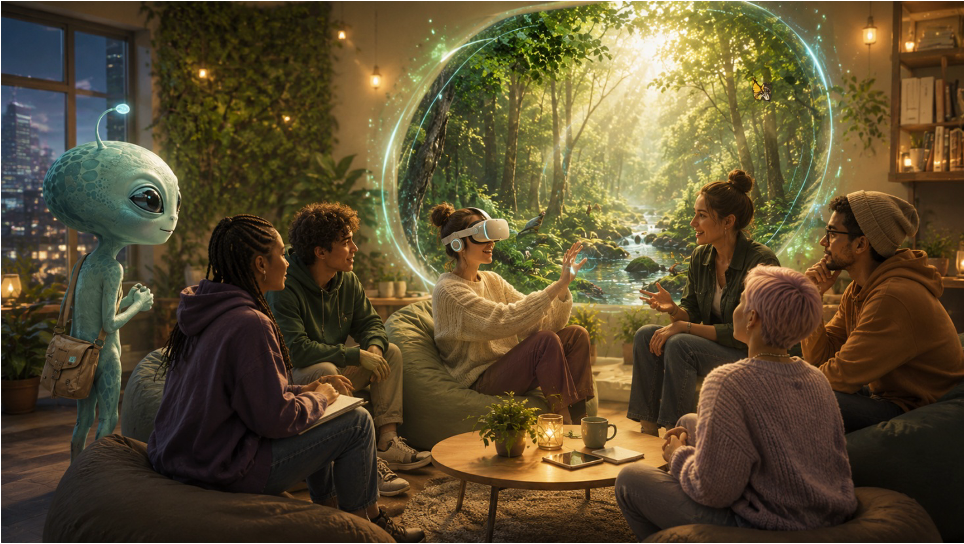
A subsequent pilot study (Sarcinella et al., 2023) refined this picture. Using a within-subjects design, the same participants experienced both the real and the virtual environment. The emotional profiles were again largely similar but certain emotional states emerged as distinct. Nostalgia and animation emotions were more intense in real condition. State anxiety, on the other hand, was higher in VR, but significantly correlated with the sense of presence: the more present people felt inside the virtual environment, the less anxious they became.
This hints at something important: the quality of the virtual experience itself (in other words, how immersive, how well-designed, how emotionally coherent) may shape not only what people feel, but whether they can relax into feeling it at all. This gives NatureVR a meaningful starting point. They tell us what to look for, what to measure, and what to take seriously as we begin to design virtual nature experiences for a specific purpose: supporting young people’s connection to the natural world.
Why this matters for NatureVR
For Hopir, this was the real discovery: virtual nature is not only a question of pixels, trees and soundscapes. It is a question of experience design. NatureVR does not aim to create a virtual environment that is simply beautiful to look at. Its ambition is more specific and more demanding: to develop evidence-informed tools that youth workers can use with young people to support nature connection, well-being, reflection and environmental awareness.
The difference matters. A VR environment that looks like a forest is not, by itself, an educational or therapeutic resource. It becomes one through the choices made in how it is designed, how it is used, what happens before and after the headset goes on, and how the experience is integrated into the broader work of youth practitioners.
This is precisely where research plays its role. The questions being asked by researchers about emotional responses, presence, restoration, attention, aesthetic engagement, and the meaningful differences between real and virtual experience are not just academic curiosities. They are the foundation on which design responsible depends. Without that foundation, “virtual nature” risks becoming a claim rather than a practice: impressive on a screen, unclear in its effects, and potentially misleading in its promises.
What Hopir finally understands
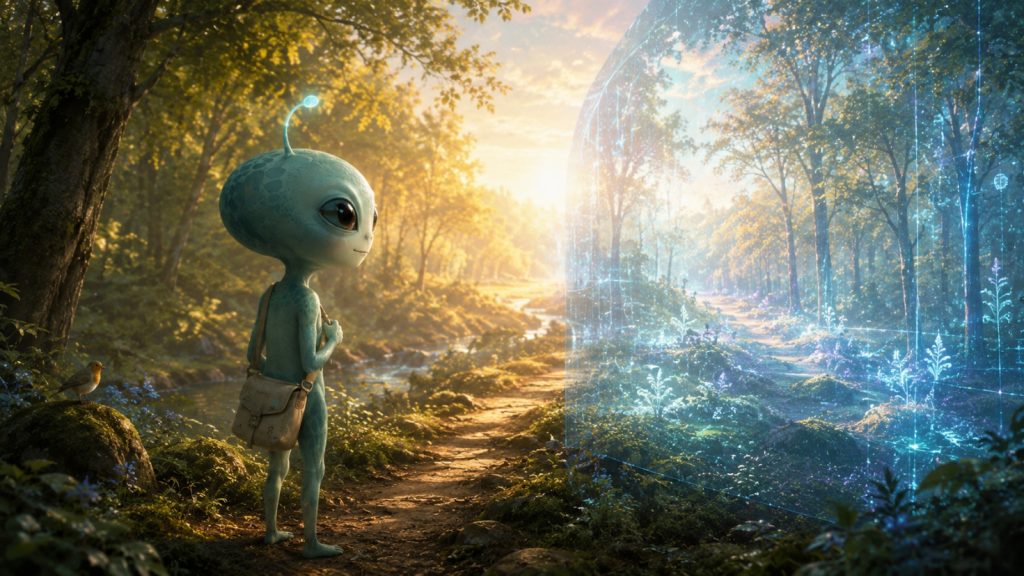
Hopir eventually left the forest. Not because the instruments had finished collecting data, but because something else had become clear. Humans do not love nature only because it is beautiful. They love it, in some cases, because it reminds them that they are alive and temporary and part of something that was here long before them and will continue without them. They love it because it asks nothing of them. Because it restores something that ordinary life depletes. Because it is, in the truest sense of an overused word, restorative.
Virtual nature cannot give someone that. Not fully, in the same way. But if designed with care, built on evidence, and used by people who understand both its possibilities and its limits, it may help some young people approach nature, remember it, imagine it, or reconnect with it. It may lower the distance. Open the door. And that, Hopir concluded, filing away the last of the anomalous data under a new category simply labelled meaning, is not nothing.
We are not simply asking whether virtual nature looks real. We are asking whether it can feel meaningful, and how research can help us design it responsibly.